
When luxury automaker Mercedes-Benz needed to launch 12 new paint color variants across their entire model lineup, they faced a familiar challenge: schedule another multi-million-dollar photoshoot or find a smarter way. They chose the latter. Today, Mercedes-Benz, along with BMW, Tesla, Audi, and most premium automotive brands, has shifted its primary product visualization strategy from traditional photography to photorealistic 3D rendering.
This isn’t just a trend. It’s a fundamental industry pivot driven by economics, speed, and quality. And if you’re an automotive brand still relying heavily on traditional photography, you’re already behind.
“Let’s Discuss Your Project & Bring Your Ideas to Life”
The Silent Crisis: Why Traditional Automotive Photography Is Breaking Down
For decades, automotive photography was the gold standard. A polished car on a sunlit desert highway, interior shots in a studio, and detail renders of engines and craftsmanship, all executed by specialists with six-figure equipment budgets and complex logistics.
But the model is cracking under its own weight.
The Cost Trap
A professional automotive photoshoot is staggering in scope. Consider what’s actually involved:
- Pre-production: Location scouting, permit acquisition, set design, prop sourcing
- Production: Professional vehicle transportation, dedicated studio rental, equipment setup, photographer fees (often $3,000–$5,000 per day)
- Personnel: Photographer, assistant, stylist, gaffer, grip, and photo retouchers (typically 5–10 people)
- Post-production: Color correction, background removal, compositing, asset management
For a single automotive photoshoot covering one model in 3–4 environments, brands typically budget $15,000–$50,000. For a full product line with multiple colors, trims, and configurations? Double or triple that.
The Multiplication Problem
A car comes in 8 colors, 3 trim levels, and 4 interior variations. That’s 96 possible configurations. In traditional photography, each variation that needs to be shown (especially for e-commerce or marketing configurators) requires either a different physical vehicle or hours of Photoshop manipulation.
Now multiply this across a global launch spanning 5 markets with different regional specifications. A single automotive brand might need hundreds of individual product images. Each one traditionally requires coordinating physical assets, studio time, and post-production labor. The result? A continuous cycle of expensive, time-intensive photoshoots that never quite keep up with market demands.
The Schedule Bottleneck
Photography is bound by the tyranny of scheduling. A photographer’s availability, studio bookings, location permits, and vehicle logistics create hard constraints. If a campaign needs to launch in 6 weeks and your photographer is booked for the next 4, you’re waiting.
Worse, what if you need to reshoot because the client requests a different angle, a new background, or updated styling? That’s another 2–3 weeks, another production budget, another round of coordination. In automotive marketing, where timing can make or break a product launch, these constraints are costly.
The Shift: Why Automotive Brands Are Choosing 3D Rendering
The transformation accelerated around 2020–2022, when rendering technology crossed a critical threshold: photorealism became indistinguishable from photography for most marketing applications. Automotive manufacturers began adopting 3D visualization not just for internal design and prototyping but also to enhance the consumer experience through virtual showrooms and configurators. The shift wasn’t optional. It was inevitable.
The Economics Are Undeniable
Once a master 3D model is created, the economics transform entirely. A single digital car model can be rendered in infinite variations without creating new physical assets. Want to show the same car in 8 colors? That’s no longer 8 photoshoots. It’s 8 material swaps and 8 render passes, work that takes hours, not weeks.
Clients who make this shift have achieved 30–90% cost savings compared to traditional photography by eliminating the most expensive and time-consuming elements of physical production. Because 3D rendering requires no product shipping, no sample builds, no set construction, and no reshoots, brands avoid the logistics and labor that inflate photo budgets.
Photography vs. 3D Rendering at a glance:
| Production Factor | Photography | 3D Rendering |
|---|---|---|
| Single image cost | $500–$2,000 | $100–$500 |
| Per-variant cost | Full reshoot required | Minimal (material/angle change) |
| Timeline | 4–8 weeks | 1–2 weeks |
| Revisions | Requires rescheduling | Digital adjustments (hours) |
| Scaling variants | Linear cost increase | Exponential efficiency gain |
For an automotive brand launching 50 product images per month across regions, the annual savings are substantial, often exceeding $500,000.
Speed Is Now a Competitive Advantage
In today’s market, timing is strategy. Traditional photography involves slower production timelines because equipment, locations, and step-by-step setups limit flexibility. By contrast, 3D rendering operates on a completely different timeline. Once the base model is complete, new renders can be produced in days. This means:
- New color variants can be visualized before physical production begins
- Marketing campaigns can launch simultaneously across regions without coordination delays
- Last-minute design changes don’t require an expensive reshoot
- A/B testing of visual concepts happens in hours, not weeks
Premium automotive brands like Audi, BMW, Mercedes-Benz, and Tesla invested early in real-time visualization to reinforce innovation, reduce inventory dependency, and elevate the buying experience. These early adopters gained years of competitive advantage by responding faster to market demands.
Quality: Photorealism Has Arrived
The skepticism is understandable. Five years ago, you could spot 3D renderings immediately. The lighting was off, the materials looked plastic, and the reflections were wrong. That era is over.
Modern rendering engines like V-Ray, Arnold, and Blender’s Cycles have reached a level of sophistication that rivals photography for most applications. Luxury brands in the furniture, automotive, and jewelry sectors have been using CGI imagery for years precisely because it gives them complete control over every visual element. Advanced rendering engines now:
- Accurately simulate physically-based light behavior, including complex reflections on metallic surfaces
- Render translucency in glass and transparent plastics with precision
- Create soft, natural shadows in various lighting conditions
- Handle complex material interactions, including chrome, carbon fiber, leather, and rubber
- Produce results that professional photographers and designers cannot distinguish from real product photography
The irony is that 3D rendering often provides superior visual control compared to photography. In a studio, a photographer is constrained by the laws of physics and the properties of available light. In 3D, you can achieve perfect lighting, eliminate unwanted reflections, and optimize every aspect of the image.
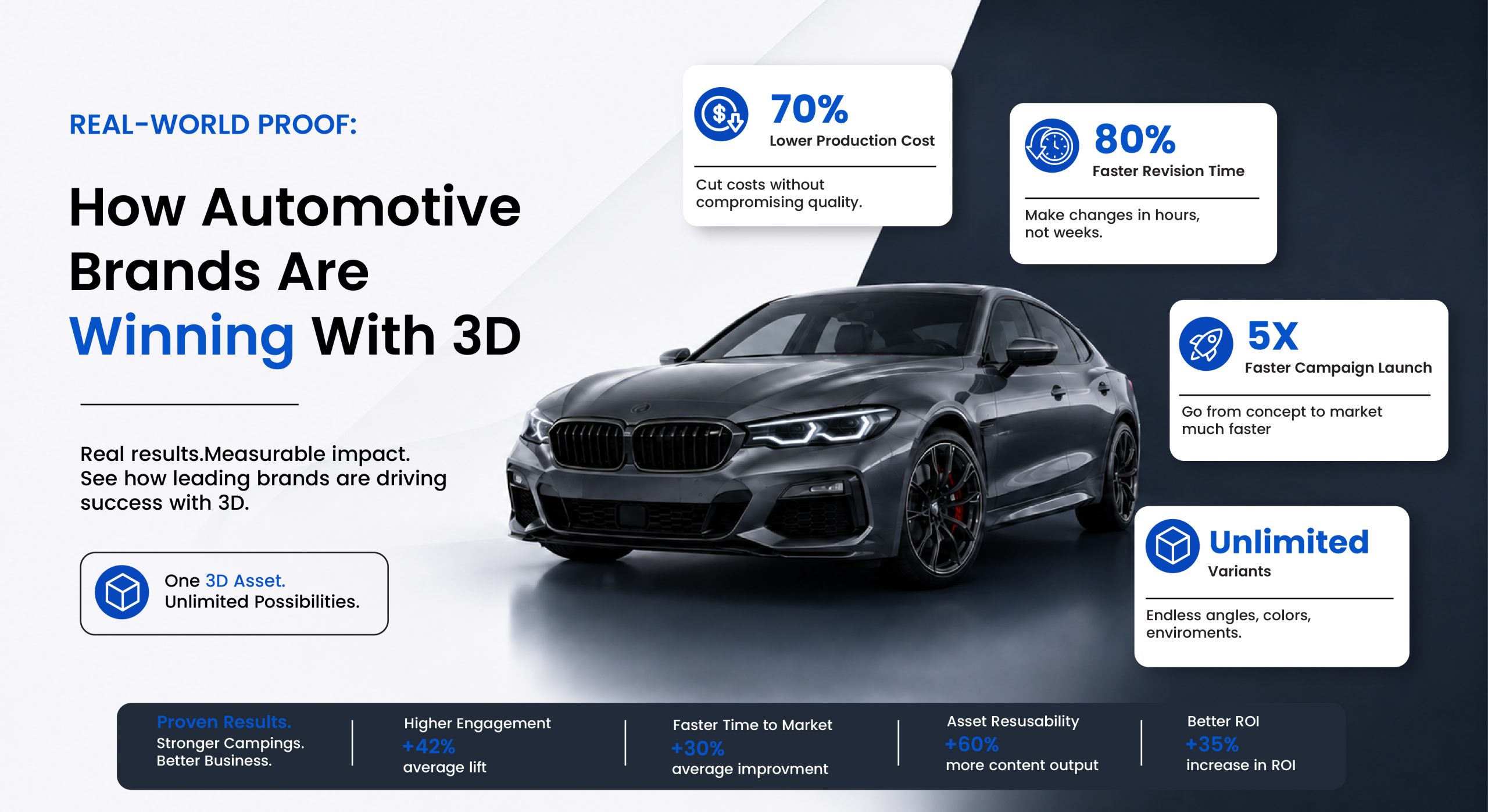
Real-World Proof: How Automotive Brands Are Winning With 3D
The shift isn’t theoretical. It’s happening across the industry right now.
- BMW’s Joytopia offers a fully interactive VR showroom with digital avatars and 3D car configurators. Customers can explore and customize vehicles in a fully immersive environment, seeing photorealistic 3D renderings from every angle.
- Tesla’s digital-first strategy allows potential buyers to explore vehicles, customize options, and interact with 3D models online. This removes dependency on physical showrooms entirely, reaching global markets without retail real estate overhead.
- Mercedes-Benz’s Virtual Experience Hub provides a virtual showroom experience with detailed 3D models, allowing customers to explore interior and exterior features with the same depth previously reserved for physical dealerships.
- Audi, Volvo, Hyundai, Toyota, Honda: All major automotive brands now operate 3D configurators and virtual showrooms at scale.
These aren’t experimental pilots. They’re production systems handling customer interactions at scale.
If BMW, Mercedes, and Tesla are betting their brand reputation on 3D rendering, it’s not a guess anymore. It’s a proven strategy.
The Broader Market Opportunity
The numbers back this up. The global 3D rendering market reached USD 4.8 billion in 2024, with a compound annual growth rate (CAGR) of 21.7% projected from 2025 to 2033, expected to reach USD 36.5 billion by 2033. Automotive is a primary driver of this growth.
What began as a brand differentiator has since become a baseline expectation. Even the affordable automobile segment has caught up. Volkswagen is a leading example with its widely adopted 3D configurators. If you’re still primarily relying on traditional photography, your competitors are already several steps ahead.
The Quality Question: When Should You Still Use Photography?
This doesn’t mean photography is dead. For certain applications, it remains valuable.
Photography still excels when:
- Showcasing a completely finished production vehicle in a real-world environment
- Capturing the tactile qualities of materials that benefit from imperfect, organic textures (worn leather, weathered paint)
- Creating lifestyle marketing imagery that requires authentic human interaction or real environmental context
- Building trust through “behind-the-scenes” or process-driven content
3D rendering dominates when:
- Showing product configurations, variants, or customization options
- Creating configurators or virtual showrooms
- Launching before physical production is complete
- Producing large volumes of variations or marketing assets
- Speed and cost-efficiency are critical
- You need full control over lighting, angles, and environmental conditions
The winning strategy for most automotive brands today is hybrid: use 3D rendering as your primary production engine for product visualization, marketing configurators, and digital showrooms. Reserve photography for high-impact, lifestyle-oriented campaigns where authenticity and real-world context add genuine value.
The Timeline: 3D Is No Longer “Future.” It’s Now
The 3D rendering software market is projected to grow from $5.64 billion in 2024 to $6.77 billion in 2025 at a CAGR of 20% and is expected to reach $13.86 billion by 2029. This acceleration is driven by three converging forces:
- Technology maturity: Rendering engines, GPUs, and cloud rendering infrastructure are now production-ready at scale
- Cost accessibility: High-quality 3D rendering is no longer exclusive to mega-budgeted campaigns
- Market demand: Consumers expect digital configurators, virtual showrooms, and interactive product exploration
If your brand is still debating whether to invest in 3D rendering for automotive marketing, you’re already making a decision by waiting. Every quarter of delay is a quarter your competitors use to build their digital infrastructure, optimize their workflows, and establish market presence.
What This Means for Your Brand
The transition from photography to 3D rendering isn’t an incremental improvement. It’s a structural shift in how automotive brands communicate with customers.
Brands that move first get:
- Faster time-to-market for new models and configurations
- Lower production costs for ongoing marketing and e-commerce needs
- Better customer engagement through interactive configurators and virtual showrooms
- Competitive differentiation through cutting-edge digital experiences
- Scalability to reach global markets without proportional increases in production costs
Brands that wait will eventually be forced to catch up. At that point, they’ll be playing defense instead of offense.
Ready to Make the Shift?
NBY IT Solutions specializes in photorealistic 3D car modeling and rendering for automotive brands worldwide. With over 15 years of experience and 100+ global brands in our portfolio, we’ve helped companies transition from traditional photography to cutting-edge 3D visualization pipelines.
Services we provide:
- High-fidelity 3D car models (interior and exterior) for marketing, e-commerce, or virtual showrooms
- Photorealistic rendering that rivals professional photography
- Product configurators to showcase color, trim, and option variations
- Virtual showroom assets for digital experiences
- Custom automotive visualization for advertising and campaigns
We deliver production-grade results on your timeline.
📧 Email: contacts@nbyit.com
🌐 Website: nbyit.com
☎️ Phone: +880 1715749788 (Bangladesh) | +1 (737) 222-1318 (USA/Canada) | +31 653211408 (Europe)
The future of automotive visualization is 3D. The question is, will your brand lead or follow?
About NBY IT Solutions
NBY IT Solutions is a Bangladesh-based digital services company specializing in photorealistic 3D modeling, animation, and rendering. For over 15 years, we’ve delivered cutting-edge visualization solutions to automotive brands, real estate companies, furniture manufacturers, and global enterprises. Based in Dhaka with offices in the USA and Europe, we combine technical expertise with deep industry knowledge to create production-ready assets that drive results.